



A barometer is a device that measures air (barometric) pressure. It measures the weight of the column of air that extends from the instrument to the top of the atmosphere. There are two types of barometers commonly used today, mercury and aneroid (meaning “fluidless”). Earlier water barometers (also known as “storm glasses”) date from the 17th century. The mercury barometer was invented by the Italian physicist Evangelista Torricelli (1608 - 1647), a pupil of Galileo, in 1643. Torricelli inverted a glass tube filled with mercury into another container of mercury; the mercury in the tube “weighs” the air in the atmosphere above the tube. The aneroid barometer (using a spring balance instead of a liquid) was invented by the French scientist Lucien Vidie in 1843.

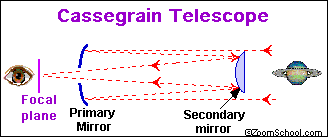
A Cassegrain telescope is a wide-angle reflecting telescope with a concave mirror that receives light and focuses an image. A second mirror reflects the light through a gap in the primary mirror, allowing the eyepiece or camera to be mounted at the back end of the tube. The Cassegrain reflecting telescope was developed in 1672 by the French sculptor Sieur Guillaume Cassegrain. A correcting plate (a lens) was added in 1930 by the Estonian astronomer and lens-maker Bernard Schmidt (1879-1935), creating the Schmidt-Cassegrain telescope which minimized the spherical aberration of the Cassegrain telescope.

Galileo Galilei (1564-1642) was an Italian mathematician, astronomer, and physicist. Galileo found that the speed at which bodies fall does not depend on their weight and did extensive experimentation with pendulums.
In 1593 Galileo invented the thermometer.
In 1609, Galileo was the first person to use a telescope to observe the skies (after hearing about Hans Lippershey’s newly-invented telescope). Galileo discovered the rings of Saturn (1610), was the first person to see the four major moons of Jupiter (1610), observed the phases of Venus, studied sunspots, and discovered many other important phenomena.

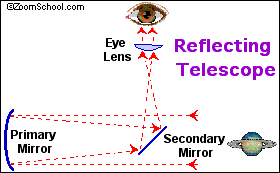 James Gregory (1638-1675), a Scottish mathematician, invented the first reflecting telescope in 1663. He published a description of the reflecting telescope in “Optica Promota,” which was published in 1663. He never actually made the telescope, which was to have used a parabolic and an ellipsoidal mirror.
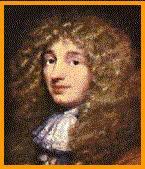
Christian Huygens (1629-1695) was a Dutch physicist and astronomer who developed new methods for grinding and polishing glass telescope lenses (about 1654). With his new, powerful telescopes, he identified Saturn’s rings and discovered Titan, the largest moon of Saturn in 1655. Huygens also invented the pendulum clock in 1656 (eliminating springs), wrote the first work on the calculus of probability (De Ratiociniis in Ludo Aleae, 1655), and proposed the wave theory of light (Traité de la lumiere, 1678).
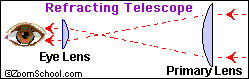
Hans Lippershey (1570-1619) was a German-born Dutch lens maker who demonstrated the first refracting telescope in 1608, made from two lenses; he applied for a patent for this optical refracting telescope (using 2 lenses) in 1608, intending it for use as a military device. A refracting telescope uses two lenses to magnify what is viewed; the large primary lens does most of the magnification.

The microscope may have been invented by eyeglass makers in Middelburg, The Netherlands, invented sometime between 1590 and 1610. Hans and his son Zacharias Janssen are mentioned in the letters of William Boreel ( the Dutch envoy to the Court of France) as having invented a 20X magnification microscope.
Robert Hooke used an early microscope to observe slices of cork (bark from the oak tree) using a 30X power compound microscope. He published his observations in “Microgphia” in 1665. In 1673, Antony van Leeuwenhoek discovered bacteria, free-living and parasitic microscopic protists, sperm cells, blood cells, etc., using a 300X power single lens microscope.
A reflecting (or Newtonian) telescope uses two mirrors to magnify what is viewed. The reflecting telescope was first described by James Gregory in 1663.
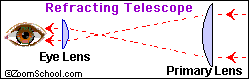
A refracting telescope uses two lenses to magnify what is viewed; the large primary lens does most of the magnification. The first refracting telescope was invented by Hans Lippershey in 1608.
A telescope is a device that lets us view distant objects. Early telescopes (and most today) used glass lenses and/or mirrors to detect visible light. Some modern telescopes gather images from different parts of the electromagnetic spectrum, from radio waves to gamma rays. Most telescopes are located on Earth, but others are in space.
Evangelista Torricelli (1608 - 1647) was an Italian physicist who invented the mercury barometer (in 1643) and made improvements to the microscope. Torricelli was a pupil of Galileo. Torricelli inverted a glass tube filled with mercury into another container of mercury; the mercury in the tube “weighs” the air in the atmosphere above the container. A barometer is a device that measures air (barometric) pressure. It measures the weight of the column of air that extends from the instrument to the top of the atmosphere. There are two types of barometers commonly used today, mercury and aneroid (meaning “fluidless”).